







Table of Contents
Momentum And Energy Overview In Two Dimensions
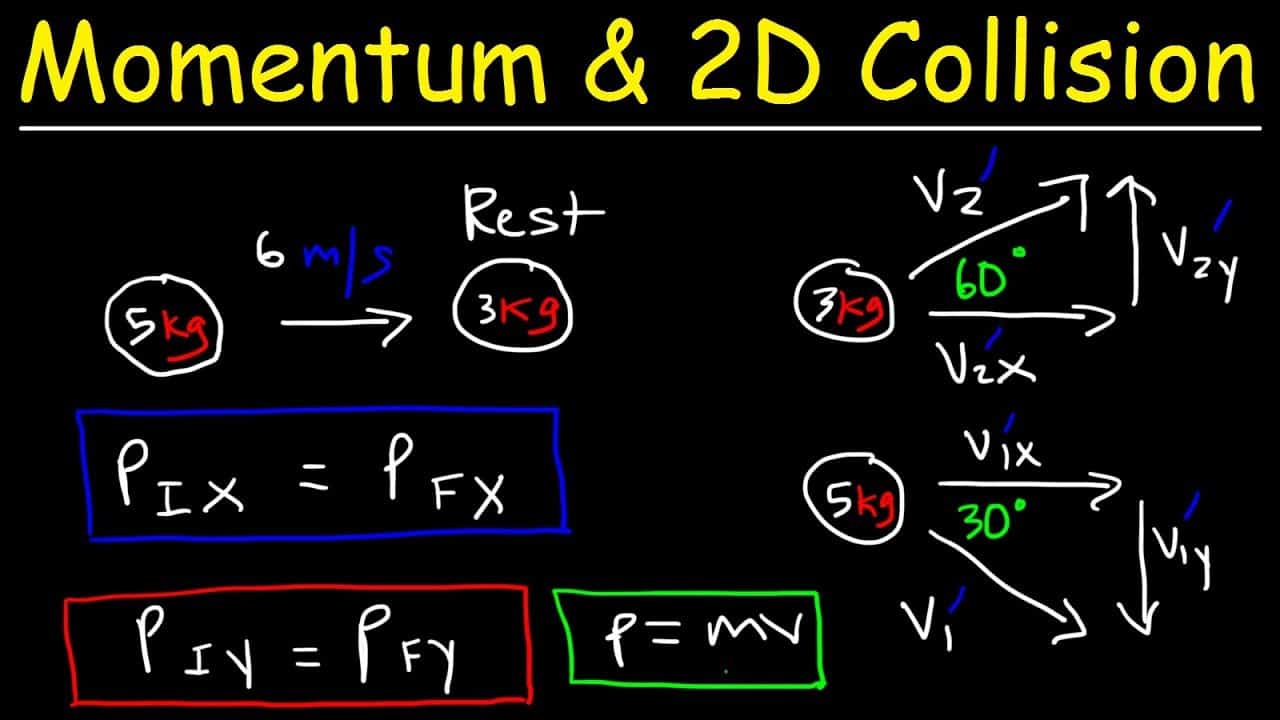
Linear momentum is defined as mass•velocity and has units of kg•m/s. Mathematically it is expressed as, p = mv, and is a vector quantity. The bold font is used to call your attention to the fact that momentum and velocity are vector quantities. If the net force acting on an object is zero, its momentum is conserved in a collision and can be expressed as pi = pf, where i and f stand for initial and final. This conservation law implies that the total momentum of the universe is constant. When discussing the conservation of momentum, one must distinguish between internal and external forces. Internal forces consist of a action-reaction pair of forces according to Newton’s third law. External forces are forces that exist due to outside influences, i.e. gravity or friction. A conservative force such as gravity does not “drain” the system of any energy. However, a force such as friction or air resistance is a nonconservative force, which converts some of the mechanical energy into heat. An ideal situation exists when the net force sums to zero and there are no net external forces. This situation gives the following result: Δp = 0, pi = pf when the momentum of the system is constant. Keeping simple what is simple, we will only consider a collision of two objects. This leads to: Δp = 0 pi = pf m1v1 + m2v2 = m1v1‘ + m2v2‘ Because there are only two objects involved in this collision, there are only two terms representing the initial momentum and two terms representing the final momentum. A second important consideration involving collisions is that of energy. For simplicity, we will consider two objects traveling on a horizontal surface without friction. There are three categories of collisions: completely elastic, completely inelastic, or somewhere in the middle. Given that the ΣFnet = 0, momentum will be conserved but this is not necessarily true about kinetic energy, KE. Remembering that energy can take many forms i.e. heat, light, and sound, a perfectly elastic collision only exists when ΔKE = 0. If the kinetic energy of the system equals zero after a collision the collision is said to be completely inelastic. Through an unfortunate choice of words, it sometimes sounds like energy is “lost”. Energy is not lost but rather converted into undesirable forms which decrease the kinetic energy of a system. Keeping simple what is simple, we will only consider a collision of two objects. For an inelastic collision, the following is true: ΔKE ≠ 0 KEi ≠ KEf 1/2m1v12 + 1/2m2v22 ≠ 1/2m1v1‘2 + 1/2m2v2‘2 and for an elastic collision, the following is true: ΔKE = 0 KEi = KEf 1/2m1v12 + 1/2m2v22 = 1/2m1v1‘2 + 1/2m2v2‘2 Another must to remember is that energy is a scalar quantity. Unlike momentum which is a vector that you resolve vector components, energy is a scalar and a negative sign simply represents a decrease in energy. These concepts will become clearer as you use the simulator and work through some of the problems.
